Micro Guide
What micro actually is
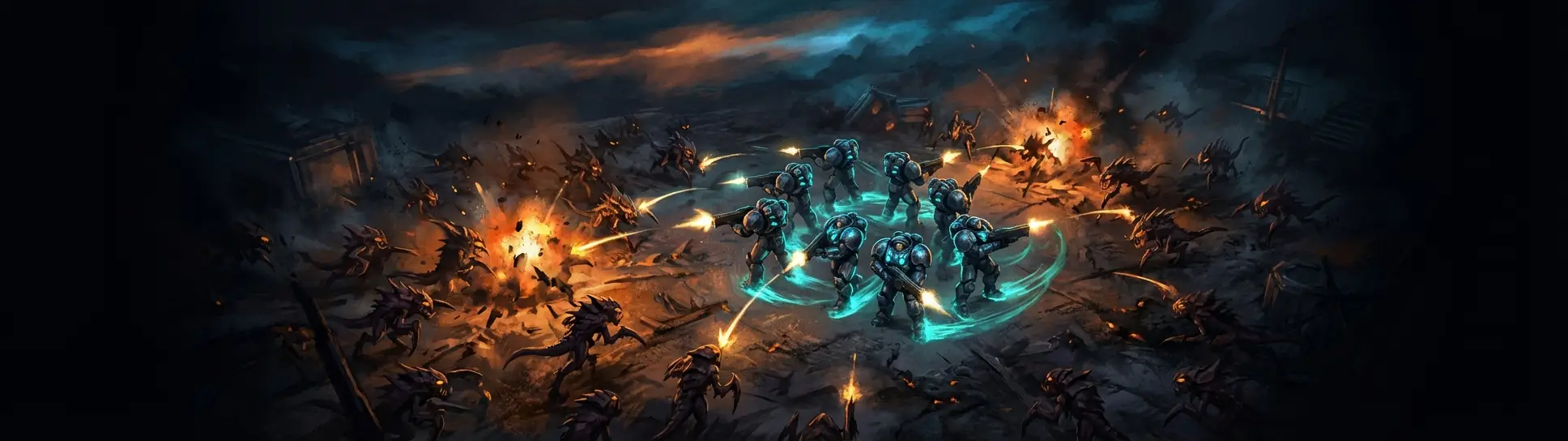
Micro is the control of individual units during combat. Moving a wounded Stalker to the back of your army so it doesn’t die. Splitting your Marines apart so a single Baneling doesn’t kill 15 of them. Blinking a low-health Stalker backward while the rest of the pack keeps shooting. It’s everything you do with your army once the fight starts.
Macro is what you do between fights: building workers, expanding, spending your money, producing units. Micro is what you do during fights. The two skills feel very different. Macro is about rhythm and routine. Micro is about reaction and precision. Both matter, but they don’t matter equally at every level of play.
When micro matters (and when it doesn’t)
Here’s the honest truth that nobody on Reddit wants to hear: below Diamond, micro barely matters. If you’re in Gold league spending your APM on fancy Marine splits while floating 1500 minerals back home, you’re losing games that better spending would have won. A Gold player who A-moves 180 supply into a Gold player who beautifully micros 130 supply is going to win that fight almost every time. Having more stuff is the strongest micro technique in the game.
That said, there are situations where basic micro matters at every level. Pulling a damaged unit back during a fight costs you nothing and keeps it alive. Running your workers away from Reapers or Oracles instead of letting them die is huge. Moving your army out of Storm is free. You don’t need 200 APM for any of this. What I’m arguing against is the player who watches ByuN highlight reels and thinks the path to Platinum is learning to split like a GM.
Once you hit Diamond, the equation shifts. Players there have solid macro, so games are decided by who uses their army better. In Masters and above, a single well-placed EMP or a missed Storm can flip a 200 vs 200 fight. At that level, micro is a real differentiator. But you have to earn the right to focus on it by getting your fundamentals solid first.
Stutter-stepping (kiting)
This is the most universally useful micro technique. The idea: your ranged units have a delay between attacks. During that delay, they’re just standing there doing nothing. If you move them forward (or backward) during that gap, you get free distance without losing any damage output.
The classic example is Marine kiting against Zerglings. A Marine fires, you move-command forward, the Marine walks a few steps, you attack-command, the Marine fires again. Zerglings are melee, so every step your Marine takes while they’re chasing is a step where you’re shooting and they’re not. Done well, a small group of Marines can kill a much larger group of Zerglings by never letting them close the gap.
Stalkers do the same thing against slower units. Blink Stalkers take it further: you can Blink a low-HP Stalker backward, let the rest keep shooting, then Blink the next one that drops low. The net effect is your opponent kills zero Stalkers while you kill several of their units. That’s a fight that looks even on paper but ends up completely one-sided.
To practice: load up a custom game, make 10 Marines, and make 20 Zerglings for the opponent. Try to kite the Zerglings and kill them all without losing a Marine. It’s harder than it sounds. Once you can do it reliably, bump the Zergling count to 30.
Focus fire
By default, your units distribute their attacks across whatever enemies are closest. This is usually fine, but against high-HP units it’s wasteful. If you have 10 Stalkers fighting 5 Immortals, your Stalkers will spread their damage across all 5 Immortals, killing none of them for a long time. If instead you right-click a single Immortal, all 10 Stalkers focus it down fast. Now it’s 10 Stalkers vs 4 Immortals with your next volley, then 10 vs 3. Focus fire turns a losing fight into a winning one.
The cost is attention. Every second you spend clicking on specific units is a second you’re not doing something else. The trade-off is worth it for high-value targets: Tanks, Colossi, Medivacs, Infestors, High Templar. Taking one of those down early in a fight changes the entire dynamic. It’s not worth it for Marines or Zerglings. Let your units auto-target the small stuff and save your attention for the units that matter.
Spell usage and caster micro
Casters win fights at the highest level. A full-energy High Templar with Storm can deal 80 damage to every unit in the target area. Two Storms on a clumped bio army can kill it outright. A single EMP from a Ghost strips 100 shield points from every Protoss unit it hits. Fungal Growth from an Infestor roots an entire army in place for 3 seconds while your Banelings roll in.
The key with casters is positioning. Your High Templar should never be at the front of your army. They should be behind your Stalkers and Zealots, close enough to cast but far enough back that they don’t get sniped before they use their energy. Same with Ghosts: they need to EMP before the fight starts or in the first second of engagement. If your Ghost walks into a Storm trying to get in EMP range, that’s a 200/100 resource unit you traded for nothing.
Tabbing between control groups is how you manage spellcasters in a fight. Keep your casters on a separate control group from your main army. When the fight starts: tab to casters, cast your spells, tab back to army, stutter-step or focus fire. It sounds overwhelming, but it becomes muscle memory with practice. Start with one caster type and one spell. Don’t try to manage Ghosts, Ravens, and Liberators all at once.
Concave and positioning
Before any shooting happens, the fight might already be decided by where each army is standing. A concave means your units are spread in an arc so that more of them can fire at the same time. If your opponent walks through a narrow ramp into your pre-spread army, only their front units can shoot while all of yours can. That’s a won fight before it starts.
Ramps, choke points, and open ground all change the math. Siege Tanks on high ground behind a wall of Supply Depots are much harder to kill than the same Tanks in an open field. A Zerg army fighting on creep moves 30% faster than the same army off creep. Where you take the fight matters as much as how you fight it. If your opponent is pushing into you, don’t run your army straight at them. Set up in a good position and let them come.
Splitting
Splitting is about spreading your units apart to minimize area damage. It’s most associated with Terran bio against Banelings and Storms, but every race needs to split against something.
The Terran bio split is probably the highest-APM micro technique in the game. Banelings deal 35 damage each in a small area. A clumped group of Marines will melt instantly. But if you split your Marines into small groups, each Baneling only kills one or two instead of eight. Pre-splitting before the fight starts is more effective than trying to split reactively once Banelings are already on top of you. As you move across the map, keep your bio spread out. You can box-select small groups and move them in different directions. It’s tedious but it wins games.
Protoss needs to split against Disruptors, Tanks, and Storms (in PvP). Zerg needs to split against Hellbats, Tanks, and Colossi. The principle is the same: if your opponent has splash damage, don’t give them a clumped target. Spread out on the approach and engage from multiple angles when you can.
Race-specific micro
Terran
Terran micro revolves around the bio ball. Stim gives your Marines and Marauders a speed and attack boost at the cost of 10 HP. Knowing when to stim matters: stimming into a fight you were going to lose anyway just means you die faster with less HP. Stim when you’re engaging on your terms, not when you’re running away. Medivac micro is the other big one. Dropping units in the opponent’s mineral line forces them to pull their army back. Loading up damaged units and boosting away saves army value. And the Medivac heal means your bio ball is regenerating HP between fights while their army isn’t.
Protoss
Blink Stalkers are the definitive Protoss micro unit. Blinking wounded Stalkers to the back while the full-HP ones keep shooting is one of the most satisfying things in the game. Prism micro is the other signature skill: load a Prism with Immortals, fly it over the enemy mineral line, drop, kill workers, pick up, fly away. It’s devastating when executed well. For Gateway armies, the main micro is making sure your Zealots are in front (absorbing damage) while Stalkers and Sentries stay behind. A well-placed Force Field from a Sentry can cut an army in half, letting you fight part of it while the rest watches from the other side of the wall.
Zerg
Zergling surrounds are the bread and butter. Zerglings are fast and cheap, but they’re melee. If they attack into a wall of Marines, only the front Zerglings can hit anything. But if you wrap around the Marines from multiple sides, every Zergling is attacking and the Marines can’t kite because there’s nowhere to go. Send a group of lings to flank while the rest engage from the front. Baneling connections are the other big one: you need your Banelings to actually hit clumped units, not detonate on the first Zealot they touch. Use move-command to slide Banelings past the front line, then attack-move into the squishier units behind.
The micro vs macro debate
There’s a classic argument in the SC2 community: “should I focus on micro or macro?” The answer depends entirely on where you are. Below Diamond, macro is almost always the bigger lever. A Platinum player who improves their economy to Diamond-level standards will promote even if their micro stays the same. A Platinum player who learns GM-level splits but still floats 2000 minerals will stay in Platinum.
The right framing isn’t micro vs macro. It’s: where am I losing the most value? If your replays show that you lost every fight despite having equal or greater supply, your micro needs work. If your replays show that you entered every fight with 30 less supply than your opponent, your macro needs work. The replay data tells you which one. Trust it over your gut feeling, because your gut is biased toward remembering the flashy fight you lost and ignoring the two minutes of idle production before it.
What replay analysis shows about your fights
When you upload a replay, the fight analysis breaks down each engagement by resources lost on each side. That number is more honest than your memory. You might remember a fight as “close” when you actually lost 2500 resources and only killed 1400. Or you might think you got destroyed when in reality the trade was even, and you lost the game because you didn’t remake your army fast enough afterward.
Look at the fight timeline alongside the economy graphs. A fight where you traded evenly but your opponent remaxed 30 seconds faster means the problem wasn’t micro. It was production. A fight where you had equal supply but lost twice as much? That’s a micro or composition problem. The numbers separate the two so you know exactly where to improve.
See how your fights actually went
Upload a replay and get a fight-by-fight breakdown showing resources traded, army supply, and where you won or lost value in each engagement.
Upload a Replay