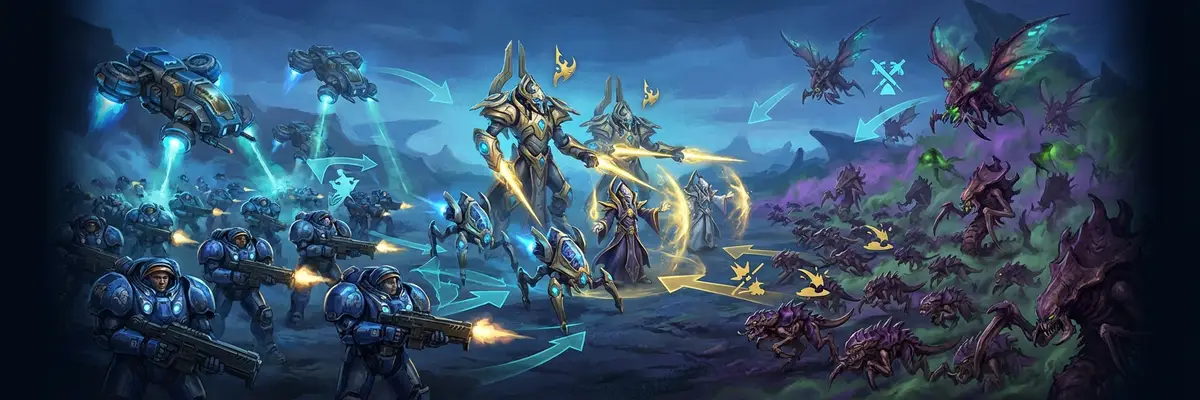
Army Composition Guide
SC2 Unit Counter Quick Reference
| Unit | Strong Against | Weak Against |
|---|---|---|
| Marine | Light air, Zerglings, Zealots | Banelings, Colossi, Storms, Lurkers |
| Marauder | Armored units (Stalkers, Roaches) | Zealots, Zerglings, Banelings |
| Siege Tank | Infantry, light ground, Zerglings | Immortals, Brood Lords, flanks while mobile |
| Ghost | Biological (Snipe), shields (EMP) | Zerglings, light harassers |
| Immortal | Armored (Tanks, Stalkers, Roaches) | Light units, Banelings, Zealots |
| Colossus | Light bio (Marines, Zerglings) | Corruptors, Vikings, Void Rays |
| Disruptor | Clumped bio and gateway armies | Spread units, mobile armies |
| Stalker | Air units, light ground | Immortals, Marauders (armored) |
| Baneling | Light units (Marines, Zerglings) | Armored units, Marauders, Sieged Tanks |
| Roach | Gateway units, Marines | Immortals, Colossi, Siege Tanks |
| Hydralisk | Air units, light ground | Siege Tanks, Colossi, Lurkers block path |
| Lurker | Infantry, gateway armies, sieged positions | Ultralisk, Blink Stalkers, EMP |
Why Composition Beats Supply Count
You can max out at 200 supply and still lose a fight in four seconds. It happens all the time. Someone masses 80 Marines, walks into three Colossi with Extended Thermal Lance, and their entire army evaporates before they can stim across the gap. The resources are gone, the supply is gone, and the game is basically over.
SC2 is not about who has more stuff. It's about who has the right stuff. A 150-supply army with proper counters will trade efficiently against a maxed army that has none. This is probably the single most important concept to internalize if you want to improve past platinum. Your economy gets you the resources, but how you spend them is what wins fights.
Damage Types, Armor Types, and Bonus Damage
Every unit in SC2 has an armor type: light, armored, or neither (some are both, some are massive). And a lot of units deal bonus damage to specific armor tags. Marauders get +10 vs. armored. Immortals get +30 vs. armored. Hellions get +6 vs. light. These bonuses are enormous and they completely dictate which fights you win.
Here's a practical example. Stalkers have 80 HP, 80 shields, and the armored tag. An Immortal hits for 50 damage per shot and gets that +30 vs. armored. So each Immortal shot does 50 to a Stalker. Meanwhile Stalkers do 13 damage per shot, 14 with the armored bonus. The math is brutal. Two Immortals shred a group of Stalkers before the Stalkers can scratch them. But throw Zealots in front? The Immortal's damage is wasted on cheap 100-mineral units while the Stalkers fire from behind. Composition matters at every level.
Splash damage is the other big factor. Siege Tanks, Colossi, Banelings, Disruptors, Storm from High Templar. These all punish clumped-up armies. A single good Disruptor shot can kill 2000+ resources worth of bio. Understanding which units have splash and how to spread against it (or abuse it) is half the game.
Terran: Bio vs. Mech
Terran has two main army styles and they play almost like different races.
Bio means Marine, Marauder, Medivac, with Widow Mines or Liberators mixed in. It's mobile, it's aggressive, and it lives or dies on your ability to micro. Bio wants to be everywhere at once: dropping, poking, splitting against Banelings. If you're playing bio against Zerg you need Widow Mines for the Banelings and Liberators for the Corruptors later. Against Protoss, Ghosts become mandatory for EMP on High Templar and Archons.
Mech means Siege Tanks, Hellbats, Thors, sometimes Cyclones. It's slow, it's expensive, but it's very hard to break when set up. Mech is strong in TvT and TvZ. Against Protoss it struggles because Immortals eat Tanks alive and Chargelots dive past the tank line. If you go mech vs. Protoss, you need Liberators and Ghosts to hold it together, and even then it's rough.
Protoss: Gateway, Robo, Stargate
Protoss army composition revolves around which tech path you lean on. Gateway units (Zealots, Stalkers, Adepts, Sentries) are your bread and butter. They're cheap, they build fast, and they form the backbone of every Protoss army. But gateway units alone fall off hard in the mid-game. You need the expensive stuff behind them.
Robo tech gives you Immortals (amazing vs. anything armored), Colossi (amazing vs. bio), and Disruptors (amazing if you land the shots, useless if you don't). If you see mass Roach or mass Marauder, Immortals are the answer. If you see Marines or Hydralisks, Colossi melt them.
Stargate gives you Void Rays, Oracles, Phoenixes, Carriers, and Tempests. Phoenix/Adept is a real opener in PvZ that lets you harass while denying Overlord scouting. Late-game Carriers are terrifying if you get there, but they take forever to build and die hard to Corruptors or Parasitic Bomb. You usually want a mix of all three tech paths by the late game, not pure anything. For a complete breakdown of Protoss unit production, Chrono Boost usage, and matchup-specific transitions, see our Protoss guide.
Zerg: Waves and Transitions
Zerg army composition is all about transitions. You start on Ling/Bane or Roach/Ravager in the early game because those units are cheap and come from Hatchery-tech. Then you transition into the mid-game comp that counters what your opponent is doing.
Hydra/Lurker is incredible against ground-heavy armies. Lurkers straight up zone out bio and gateway armies. Mutalisk/Corruptor is your air play, good for map control and harass but fragile against Thors or Phoenixes. Brood Lord/Infestor is the classic late-game ZvT and ZvP comp that's almost unbeatable if you get there, but it takes a long time to tech into and you're vulnerable during the switch.
The key Zerg skill is knowing when to transition. If you stay on Roach/Ravager too long against a Terran going Siege Tanks, you're going to have a bad time. Check your build order timings to make sure your transitions hit before your opponent's army hard-counters yours.
Scouting and Adapting
The best army comp in the world is useless if it's built blind. You have to scout. A Reaper or Overlord in the first two minutes tells you what your opponent opened with. A scan or Observer at the five-minute mark tells you what they're transitioning into.
What to look for: building count and type. If Terran has three Barracks with Tech Labs, that's Marauder-heavy bio. Two Factories with a Starport? Mech with Medivac or Liberator support. Protoss with a Twilight Council and Robotics? Probably Blink Stalker into Immortal. Double Stargate? Void Ray or Phoenix pressure. The buildings tell you what units are coming 60 seconds from now, which is enough time to start the right counter-tech.
Check our replay analysis guide for more on reading game states and timings from your replays.
Common Army Comp Mistakes
Going pure one unit. Pure Void Ray, pure Roach, pure Marine. It works in bronze and silver because nobody there makes the counter. Above gold, people will scout it and build the three units that hard-counter yours. Always mix unit types so you don't have a single point of failure.
Not transitioning. You open Ling/Bane because it's good early. But it's minute 12, your opponent has Siege Tanks and Liberators, and you're still making Banelings. They literally cannot reach the bio anymore. You needed to be on Hydra/Lurker or Muta five minutes ago.
Making expensive units without support. Carriers without ground support get sniped by a Corruptor/Viper ball. Thors without Hellbats get surrounded by Zerglings. Brood Lords without Infestors or Corruptors just die. Big expensive units need a screen of cheaper stuff to stay alive long enough to do their job.
How Replay Analysis Reveals Comp Problems
You know that game where you lost a fight you thought you should have won? The replay will tell you exactly why. The army tab shows your unit composition at every point in the game. When you lost that big engagement at 10 minutes, you can see you had 30 Stalkers and zero Immortals against a Terran who had 8 Siege Tanks. That's not a micro problem. That's a comp problem.
The battle breakdown will show you the trade efficiency. If you're consistently losing more resources than your opponent in fights, it's probably not mechanics. It's probably comp. Look at what they had, look at what you had, and figure out what unit you were missing. Nine times out of ten, the answer is obvious once you see the numbers.
FAQ
What is army composition in StarCraft 2?
What counters Protoss in SC2?
What counters Zerg in SC2?
What counters Terran bio in SC2?
How do I know when to transition my army composition in SC2?
What is the best army composition in StarCraft 2 in 2026?
What is the best SC2 unit counter chart to use?
How do I use SC2 unit counters effectively mid-game?
What SC2 units counter mass air armies?
See your army composition breakdown
Upload a replay