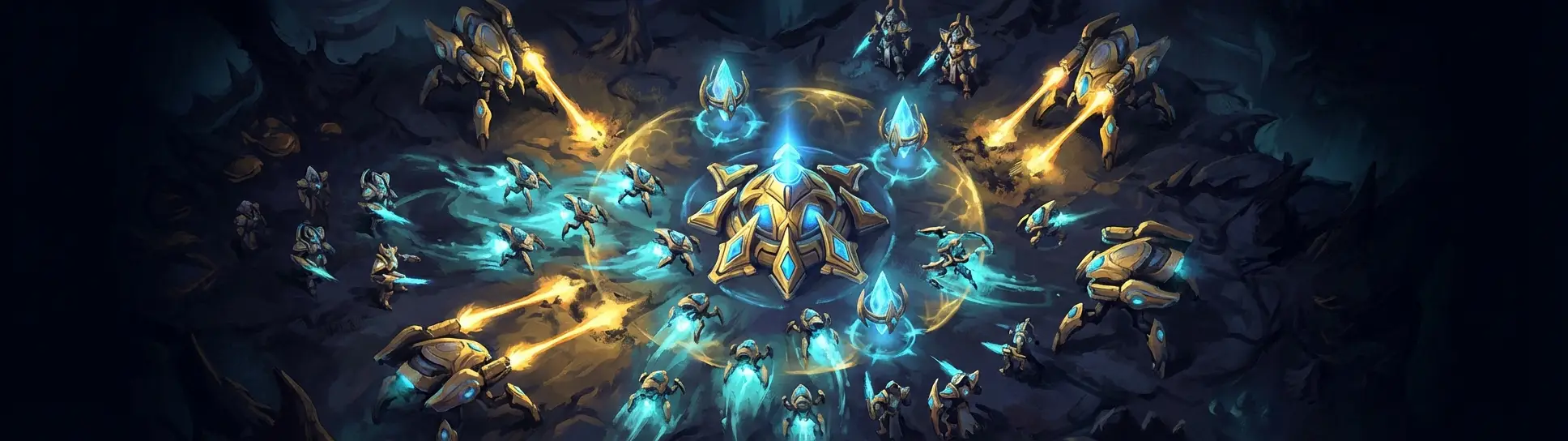
Protoss Guide
What makes Protoss different
Protoss units are expensive and powerful. A single Stalker costs 125/50. A Zealot is 100 minerals. Compare that to a Marine at 50 or a Zergling pair at 50. You're always going to have fewer units than your opponent. Every unit you lose hurts more, and every unit you keep alive matters more.
This shapes everything about how Protoss plays. You can't just throw waves of stuff at the enemy and remax. Well, you can in the late game with Warp Gate, but early on, losing four Stalkers to a bad engagement can straight up end the game. Protoss rewards precision. Take good fights, avoid bad ones, and use your technology advantage to hit windows where your army composition is stronger than theirs.
Warp Gate: the defining mechanic
Warp Gate research finishes around 3:40 in a standard game, and it fundamentally changes how Protoss produces units. Instead of queuing from a Gateway over 20+ seconds, you warp in units anywhere you have Pylon power in about five seconds. That's an absurd advantage. You can reinforce a fight across the map instantly. You can warp in a round of Zealots behind someone's army during a push. You can turn a Proxy Pylon into a forward production facility.
The catch is that Warp Gates have a cooldown that's slightly longer than a Gateway's train time. So raw production speed is technically a touch slower. But the instant availability and positional flexibility more than make up for it. There is no reason to stay on Gateways past the early game. Ever. If your replay shows Gateway units being trained after Warp Gate finishes, that's a macro leak you need to fix.
Chrono Boost: your tempo accelerator
Each Nexus generates 50 energy over time, and Chrono Boost spends it to speed up production or research by 50%. Where you put your Chronos is one of the most underrated decisions in Protoss play.
Early game, Chrono goes on Probes. Getting to 16 Probes on your natural faster means you hit your production timing faster. Once you have your build order rolling, Chrono shifts to Warp Gate research (you want that finished as fast as possible) and then to key upgrades: Blink, Charge, weapon upgrades, whatever your game plan demands. In the mid-game, dropping Chrono on a Robotics Facility pumping Immortals or on a Stargate building Void Rays can swing a fight that happens 30 seconds later.
The mistake I see constantly is Chrono just sitting unused. Energy caps at 200 on a Nexus. If you have a full energy bar, you're leaving free production speed on the table. It doesn't matter where you spend it as long as you spend it. Check your replays. If your Nexus energy is hitting 200 at any point in the game, that's a problem.
Pylons and power fields
Every Protoss building except the Nexus needs Pylon power to function. If a Pylon dies and the buildings around it go dark, you can't produce, you can't research, and you can't warp in. This is why good Pylon placement is so important and why smart opponents target your Pylons.
Spread your Pylons. Don't stack three production buildings on a single Pylon. If a Medivac drops Marines on that Pylon and kills it, your entire production goes offline. Put Pylons behind mineral lines where they're harder to reach. And always have forward Pylons on the map for warp-in points. A Pylon next to your third base lets you reinforce it instantly. A hidden Pylon near your opponent's base gives you aggressive warp-in options. Proxy Pylons are one of the most powerful tools in the Protoss kit and cost only 100 minerals.
Shields and why unit preservation matters
Every Protoss unit and building has shields that regenerate passively. A Stalker that survives a fight at 10 HP will eventually regenerate its full 80 shields back. Shield Batteries (150 minerals, built at your base) accelerate this massively and are one of the best defensive structures in the game.
This means that trading evenly is actually losing for Protoss. Your units cost more. If you trade 1000 resources for 1000 resources, you end up with fewer units than your opponent. What you want is to take a fight, pull back when things start going sideways, let shields regen, and re-engage. This is especially true with Stalkers, which have Blink to disengage damaged units. A Blink micro player who cycles wounded Stalkers to the back and blinks them out keeps far more value alive than someone who just a-moves in and watches everything die.
Gateway compositions
Stalkers are your backbone. They shoot up and down, they have Blink, and they're available from the Cybernetics Core, which you always build. Pure Stalker falls off hard against armored units (Marauders, Roaches, Immortals) because Stalker DPS is honestly mediocre for the cost. But they're fast, flexible, and necessary in every army.
Zealots with Charge are your meat shield and mineral dump. Once you have Charge researched, Zealots close the gap instantly and start shredding whatever they touch. They're amazing at tanking for your expensive stuff and they're only 100 minerals each. In the late game, you should be warping in Zealots non-stop from eight-plus Warp Gates to keep your front line alive.
Adepts are mostly an early game unit. Their shade ability lets you scout and harass in PvZ and PvT, and they're strong against light units (Marines, Zerglings, workers). But they fall off fast. By mid-game, you're transitioning to Stalkers, Zealots, and tech units.
Sentries are situational but powerful. Guardian Shield reduces incoming ranged damage by 2, which is massive against Marines and Hydralisks. Force Field can cut an army in half during a chokepoint fight. The problem is Sentries cost 50/100, which is gas-heavy, and that gas competes with your tech units. Use them in the early game when you need them, then phase them out as your army gets more expensive.
Robotics compositions
Immortals are your answer to anything armored. +30 vs. armored means they demolish Siege Tanks, Roaches, Marauders, and Stalkers. Two Immortals behind a wall of Zealots is one of the strongest mid-game army cores in the game. If you're not sure what tech to go, "Robotics into Immortal" is almost never wrong.
Colossi delete light armies. With Extended Thermal Lance, they outrange most ground units and their beam sweeps through clumps. Marines, Hydralisks, and Zerglings melt. The counter is air (Vikings, Corruptors) since Colossi can be targeted by both ground and air. If you see your opponent building air units specifically to snipe your Colossi, consider switching to Disruptors or going Templar instead.
Disruptors are high risk, high reward. A Purification Nova that connects can do 145 damage in a huge area. That one-shots most bio units and chunks everything else. But if you miss, you've got a 21-second cooldown where the Disruptor does nothing. I find Disruptors are better than Colossi when your opponent knows how to build Vikings, because Disruptors can't be targeted by air.
Stargate compositions
Oracles are an early-game investment that scouts and harasses. Revelation reveals an area for 60 seconds. Pulsar Beam kills workers fast. One Oracle in your opponent's mineral line at the right time can kill six to eight workers before they can react. Stargate openings are popular in every matchup because of how much value one Oracle provides.
Void Rays are strong against armored and massive units (Battlecruisers, Thors, Carriers) but they're slow and terrible against Marines, Hydralisks, or Corruptors in large numbers. They have their place in certain PvP builds and as support in PvZ Skytoss compositions, but massing them blindly is a bad habit that'll get you killed above Platinum.
Carriers and Tempests are the late game air army. Carriers shred ground armies with Interceptors and Tempests outrange static defense and large targets. Getting to this composition safely is the challenge. It requires three or four bases and a long tech path. If your opponent pressures you while you're transitioning to sky, you can just die.
PvT: surviving early, dominating late
The first five minutes of PvT are about not dying. Terran has a series of timings that can kill you: Reaper harassment at 2:30, Hellion drop at 3:45, 2-1-1 Medivac push at 5:00. Your job is to scout what's coming and have the right response. Shield Battery at your natural, a Stalker for the Reaper, and an Observer or Adept shade to see what's going across the map.
Once you survive the early game, the matchup shifts in your favor. Protoss tech is stronger in the mid and late game. Colossus/Storm armies are extremely hard for bio to fight into. The Terran player knows this, which is why they're trying to end it early. Your economy guide has more on how to balance defense and greed in these openers.
In the late game, High Templar with Storm is the key unit. Psionic Storm does 80 damage over two seconds in a large area. Bio armies walk into Storm and evaporate. The counter-play is Ghosts with EMP, so the matchup becomes a spell-caster duel. If your Templar land Storms before the Ghosts land EMPs, you win the fight. If the EMPs hit first, your shields are gone and your Templar have no energy. Watch your replays to see who landed their spells first. That's usually where the fight was decided.
PvZ: controlling the mid-game
PvZ is about not letting Zerg drone freely and hitting a timing before they overwhelm you with sheer unit count. Protoss has stronger units at every stage, but Zerg remaxes faster. If you trade armies evenly at the 10-minute mark, Zerg will have a new army in 30 seconds and you won't.
Oracle or Adept openings give you early harassment to force units. An Oracle in their mineral line at 4:00 forces Spore Crawlers and Queens, which costs Drones. Adept shades across the map force Zerglings, which also costs Drones. Every Drone the Zerg doesn't make is a Drone they can't use to saturate their fourth base.
The classic mid-game composition is Immortal/Archon/Chargelot with Storm support. This army hits like a truck and Zerg doesn't have a clean answer to it when it arrives at the right timing (usually around 9-10 minutes with +2 attack). The problem is if you're late or if Zerg is already on Brood Lords. Then you need Tempest or Void Ray to deal with the Broods, and the game gets complicated.
PvP: the volatile mirror
PvP is the most volatile matchup in the game. Games can end in three minutes or go to 30. Everything one-shots everything else. Adepts two-shot Probes. Oracle Pulsar Beam kills workers in a second. Disruptor shots kill entire squads. There's very little room for error.
The opening meta revolves around Stargate (Oracle) or Robo (Immortal) openers. Stargate gives you scouting and harass potential. Robo gives you a faster Immortal, which is the single strongest ground unit in PvP. If you open Stargate and your opponent opens Robo, you need to use the Oracle to harass and slow them down, because in a straight-up ground fight, the Immortal player is ahead.
Blink Stalker is the other path, and it's aggressive. You get Blink at around 4:30, take a forward position, and try to pick off units or Probes with Blink micro. It's effective against greedy builds but weak if the opponent went for an early Immortal. Know what your opponent is doing before you commit. A single Stalker poke or an Adept shade gives you enough information to decide your mid-game plan.
Common Protoss mistakes
Sitting on full Warp Gate cooldowns. Your Warp Gates should be cycling constantly. Every warp-in cycle you miss is four to eight units that don't exist. Set a reminder, check your Warp Gates after every engagement, and keep hitting that warp-in key. In replays, look at the production tab. Gaps in warp-in cycles are the Protoss equivalent of a Terran's idle Barracks.
Not having forward Pylons. If all your Pylons are in your main and natural, you can only warp in at home. That means your reinforcements take 30 seconds to walk across the map. A Pylon at your third base, a hidden Pylon near the map center, or a Pylon near your opponent's side of the map gives you massive flexibility. Losing a 100 mineral Pylon is nothing. Losing a fight because your reinforcements arrived 20 seconds late is everything.
Chronoing nothing. Your Nexus energy should never be at 200. If it is, you're wasting production speed. Chrono your upgrades, Chrono your Immortal production, Chrono your Probes. It doesn't matter what gets the Chrono as long as something does. Free acceleration that you leave on the table is minutes of lost production over the course of a game.
Taking bad engagements. Protoss armies are not disposable. If you walk into a siege line or attack into a choke where your Colossi can't fire, you lose the game on the spot. Always fight where your army has space to spread out. Open ground favors Protoss. Ramps and chokepoints favor Terran and Zerg. If the fight doesn't look good, don't take it. Use Blink, Recall, or just walk away and wait for a better angle.
Protoss Economy Benchmarks
Target numbers: 22 Probes on main + natural by 3:30 (around when Warp Gate finishes), 36 by 5:00, and 52–56 by 8:00 across three bases. These assume you're Chronoing Probes consistently and not bleeding Nexus energy into upgrades too early. Falling short at 5:00 usually means you either lost workers to harassment or put Chrono somewhere else.
Chrono Boost priority in the first five minutes: Probes, then Warp Gate research, then Probes again. After Warp Gate finishes at 3:30–4:00, shift Chrono to your first key upgrade — Blink, Charge, or Robo tech depending on your build. A Nexus sitting at 200 energy in the early game is free production speed you gave away. In replays, cap energy is the most visible Chrono waste.
Worker count at 8 minutes is a reliable predictor. Below 44 Probes on two bases at 8:00, you're behind the economic curve. Above 52 on three bases and you're ahead. The specific number matters less than the trend — if your Probe graph shows no flat spots and climbs steadily, your economy is healthy. Flat spots are where your saturation stalled.
Key Protoss Timing Windows by Matchup
Standard Protoss timing ladder: Warp Gate at 3:30–4:00, first Immortal at 5:00–5:30, Colossus at 7:30–8:00, Extended Thermal Lance at 9:00–9:30, High Templar at 10:30–11:00. Missing any of these by more than 30 seconds usually traces to a missed Chrono, a supply block, or a build order deviation you can find in replay.
PvT timing checklist: Terran's 2-1-1 arrives at 5:00–5:30 — have a Shield Battery down at the natural and at least two Stalkers before that. Colossus sniping with Vikings starts at 7:30–8:00, so keep Stalkers nearby. Your Storm timing at 10:30–11:00 is your win condition. If Terran hasn't dealt significant damage before your Templar hit the field, the matchup swings heavily Protoss.
PvZ: Your Immortal/Chargelot/Archon timing push lands at 9:30–10:30. Zerg's Roach/Ravager all-in typically arrives at 4:30–5:30 — your Gate/Gas/Gate opener needs to hold it without burning all your Chrono on units. Zerg Brood Lords appear at 14:00+ so use your timing push before that window. In PvP, the Blink timing (4:30) and the Immortal timing (5:00) are the two decision points — read which one your opponent chose and react correctly to set up the entire mid-game.
Protoss unit spotlight: T1, T2, and T3
T1 gateway units: The Zealot is your cheapest front-liner — 2 supply, excellent in tight chokes, and powered by Charge at 3:30 or earlier. The Stalker is your workhorse at range 6 with Blink, countered by mass-fire from bio or Roach/Ravager. The Adept deals 19+13 vs. light, making it a hard counter to bio and Zergling-heavy compositions. Sentries gate-keep chokes with Force Fields and can hallucinate for scouting or baiting armies — a critical support unit in PvZ.
T2 robo and twilight units: The Immortal has 100 barrier absorbing 100 damage — ideal against armored units like Roaches, Marauders, and Ultralisks. The Colossus hits 9+9 splash, strong against bio balls but countered by Vikings or Corruptors. The Disruptor fires a Nova dealing 145+55 to shields (area), the highest single-shot damage in the game — micro-intensive but fight-winning. High Templars are your anti-bio weapon: a single Storm deals 80 damage over 4 seconds in an area, compounding against groups.
T3 stargate and fleet units: Carriers launch interceptors and require sustained DPS to be effective — countered by mass anti-air or EMP. The Void Ray deals +6 vs. armored on Prismatic Alignment and shreds capital ships and ground armor. Tempests outrange most units at 15 air range with +40 vs. massive, ideal for snipe compositions against Brood Lords or Battlecruisers. See army composition for how these units combine in practice.
How replay analysis helps Protoss players
Protoss games are often decided by one or two key moments. The fight at the third base at 8 minutes. The Storm that hit (or didn't hit) at 12 minutes. The engagement where you lost three Immortals for nothing. Replay analysis shows you exactly what happened in those moments and why.
The most useful thing to check is your Chrono Boost usage and Warp Gate cycles. These are the two macro metrics that separate a Diamond Protoss from a Masters one. If your Chrono energy is capped at any point, or if there are 10-second gaps between warp-in cycles, those are free improvements you can make before you ever think about micro or decision-making.
The army composition view tells you what was on the field when you took a fight. If you lost a mid-game engagement, look at the comp breakdown. Did you have enough Immortals? Were your Archons in the mix or were you still on pure Stalker? Did you have Storm energy when the fight started? The numbers don't lie. Usually the answer is straightforward once you look at what both sides brought to the engagement.
Want to go deeper? Our build orders guide covers the specific opener timings for each Protoss matchup. The economy guide explains when to take bases vs. invest in tech. For execution under pressure, the micro guide breaks down Blink Stalker control, Force Field usage, and Storm casting mechanics. All of it ties back to what you see in replay analysis.
FAQ
Is Protoss a good race for beginners?
What is the best Protoss build order to learn first?
How do I improve as Protoss in StarCraft 2?
What is the Protoss deathball and when should I use it?
What are the hardest matchups for Protoss?
What is the best Protoss strategy in StarCraft 2?
What is the Protoss Oracle and how should I use it?
Want to see where your Protoss macro stands?
Upload a replay